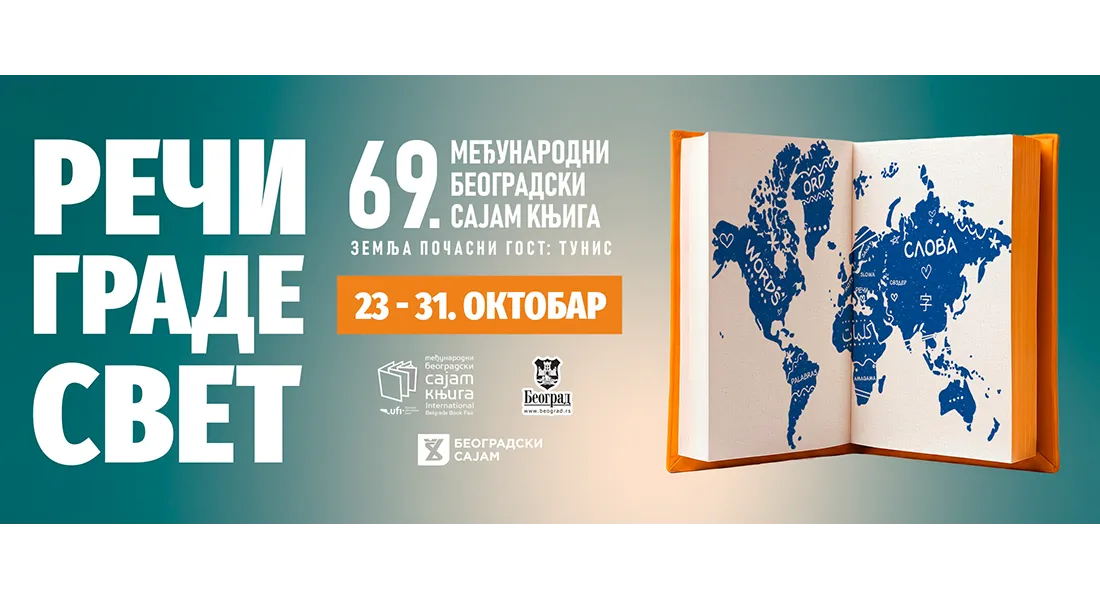
On Friday, October 23, 2026, at 6:00 PM, in Hall 2 of the Belgrade Fair, the most prestigious literary manifestation in this part of Europe—the 69th International Belgrade Book Fair—was solemnly opened.
Under the slogan “Words Build the World,” alongside more than 700 domestic and foreign participants and publishers, visitors and admirers of literature and all universal values of literary creation will be able to enjoy the beautiful word and numerous fair programs in Halls 1, 1A, 2A, and 4 until Saturday, October 31.
The Guest of Honor at the 69th International Belgrade Book Fair is Tunisia. In the central area of Hall 2, Tunisia showcases its tradition and cultural diversity—the works of scholars, writers, poets, and artists, graced by the presence of eminent guests.
In addition to Tunisia, the fair features the participation of Belarus, Bosnia and Herzegovina (Republika Srpska), Georgia, Germany, Greece, Croatia, Iran, Italy, Montenegro, Morocco, Romania, Russia, and Slovakia.
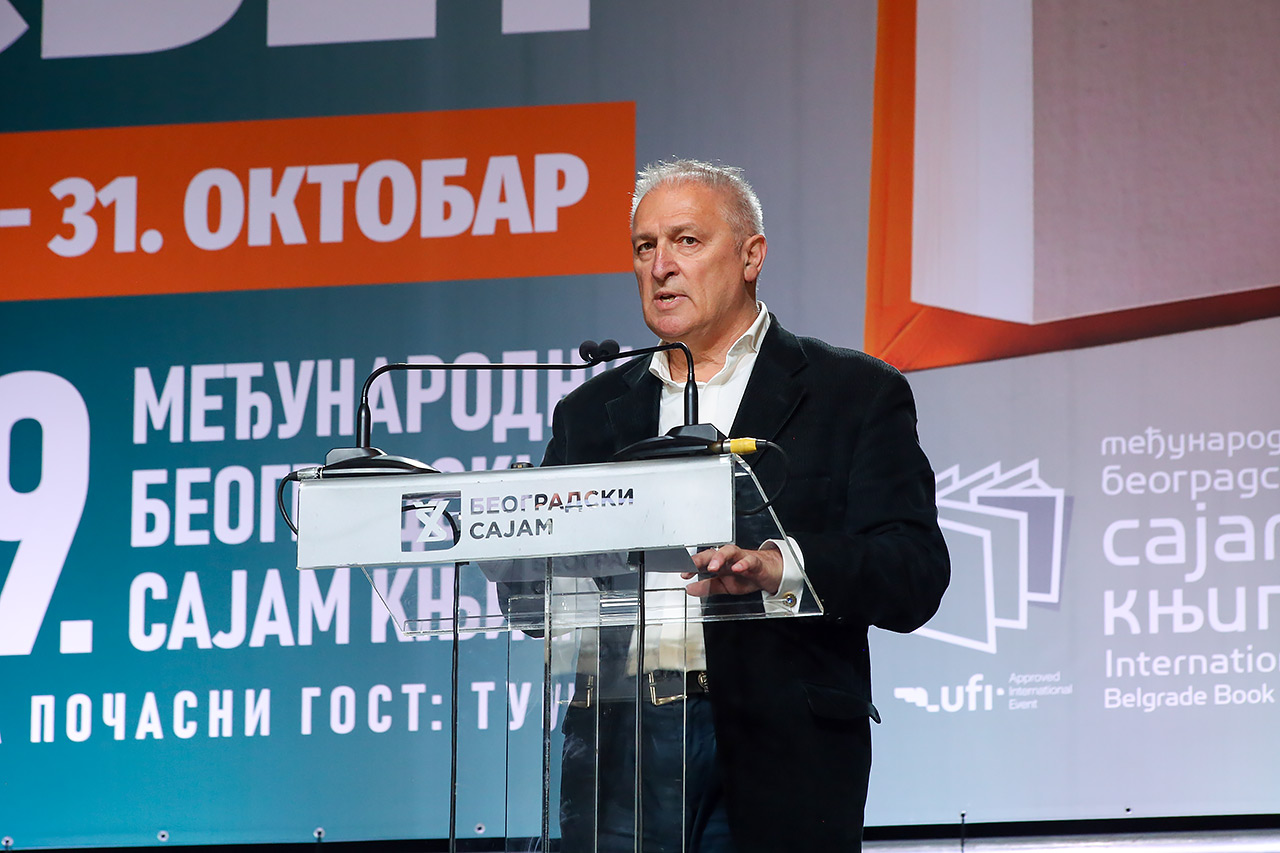
Formally proclaiming the commencement of this year’s 69th International Belgrade Book Fair, Dragan Jovanović Danilov, a writer and art critic, remarked:
“Respected publishers, dear writers, esteemed book-lovers and ‘bookosaur’ dear friends, allow me, at this venue which represents a beautiful mirror of Belgrade and Serbia, to express a few words of gratitude to our publishers and to all of you who have gathered here tonight to partake in the solemn opening ceremony of the Book Fair.
‘I have sailed through oceans and libraries’ — so wrote Herman Melville. Books and libraries are a profound solace for the anxious, splenetic soul of modern man. Books are objects endowed with both body and soul, and libraries are sacred sanctuaries. We are all textually interconnected. Hence, the truest and most precise definition of our homeland is a library. And a library is a timeless place. Libraries do not merely represent the temple of textual memory, but the central nervous system of Serbia. Being textually bound to our ancestors, we all carry the deep imprint of the library within our souls. There is no silence more beautiful or exquisite than the silence found in a library. Within such stillness, one is overcome by the sensation of having an entire eternity stretched out before them. The library is a realm of earthly delight, a veritable locus amoenus, a place of happiness. For a writer, there is no finer university than a library, nor a better teacher than experienced librarians, for whom I have coined the term—bookosaurs.
The Balkans is a space of fantastic blending of races, genetic factors, and the most disparate cultural entities. It is a region illuminated by Greek, Roman, Byzantine, and Oriental fires, offering a writer who lives and creates here extraordinary possibilities for literary creation. It remains for the Balkan writer, through a dialogue with historical memory, to test the formulas and optics of our time and our own Serbian psycho-cosmic logos.
Therefore, I now wish to direct your gaze and mine toward the golden age of Serbian culture between the two World Wars. It was a time when people were filled with unspoken words for which they desperately needed an echo. What wondrous spirits we possessed back then, and how tirelessly those individuals worked, as if they knew that libraries would burn. Among the writers, I shall mention only Ivo Andrić, Miloš Crnjanski, Rastko Petrović, and Momčilo Nastasijević. Among the philosophers: Branislav Petronijević, Božidar Knežević, and Vladimir Vujić. Among the theologians: Nikolaj Velimirović and Justin Popović. Among the painters: Sava Šumanović and Milo Milunović. Among the wondrous women: Isidora Sekulić, Ksenija Atanasijević, and Anica Savić Rebac… And all of them stood shoulder to shoulder with the greatest European minds of that era. We see the measure to which the sunbeam of heraldry bathed Serbia. For these are our heralds.
Serbian literature is rich in heralds. And who is a herald? A herald is that writer who offers people the opportunity to feel, through poetry and novels, the truth and light emanating both from this world of ours and from other realms. These are our Serbian heralds, so beloved by the Serbian people—the most refined spirits and most elevated hearts who grasp metahistorical perspectives and perceive global spiritual panoramas. These are the spirits who awakened a deep memory within us, and in whose works the awe-inspiring depths of reality and otherworldly spheres are revealed. The writers I have mentioned possessed that rare capacity for broad, all-encompassing understanding. They were preoccupied not only with the features of their own culture but also with alterity, and thus in their books, we find confirmation of our own individuality through the other—that is, the true cosmopolitanism that represents the union of the domestic hearth and the wider world.
The Book Fair is a place for our self-discovery, for our self-reflection and self-illumination. Entering the Book Fair has always carried an almost mythical dimension of pilgrimage and suspense for me. A book can live its fullest life only where enthusiasm for the book exists, only where the book is a passion for a vast number of people and where a reading culture thrives. Fairs like this contribute to nurturing such a passion and inspire us to create private, home libraries. Reading enables us to experience something truly magnificent—to realize our natural inclination toward theatricalization: the male reader assumes the role of the hero, and the female reader the role of the heroine. Reading soul-benefiting and soul-bracing books unsettles us, yet it also balances, calms, centers, and grounds us.
I am delighted that the Guests of Honor at the Book Fair are writers from Tunisia. I have had the opportunity to stay in Tunisia on several occasions and to read my poetry at a major international poetry festival in the splendid town of Sidi Bou Said. Furthermore, I have had the honor of having my poetry included in a number of international anthologies published in Tunisia in both Arabic and English, and to walk down a street in the capital city of Tunis named La rue de Serbie. On that occasion, I met extraordinary Tunisian poets. Excellent novels are also written in Tunisia, which are known to me through French translations. In this beautiful country, a poetic and prose flora unfamiliar to us flourishes, and this is an opportunity to get to know it much better.
Dear publishers, dear book-lovers, dear friends, life today has ceased to be slow. The world has changed immensely. The world is no longer firm and stable. Today, we encounter an ontological confusion, a chaos of images, books, and the music being composed nowadays. We live in an era of digital apocalypse that has disrupted all our senses, and all of this, naturally, reflects upon literature as well.
For me, time spent over books represents the most beautiful hours borrowed from destiny. From great literature comes a higher, essential happiness. One should read to achieve a blissful life. Writing and reading books are deeply intertwined with resurrection: resurrection is the essence of everything—a seed dies in the earth to rise again in wheat, in bread, in song, in a novel, in a book. And so, let us read ever anew. For when one says ‘read’, that means—as a spiritual man once said—renew, restore, repeat, remember from within by your very self, because literature is a battle for the soul.”
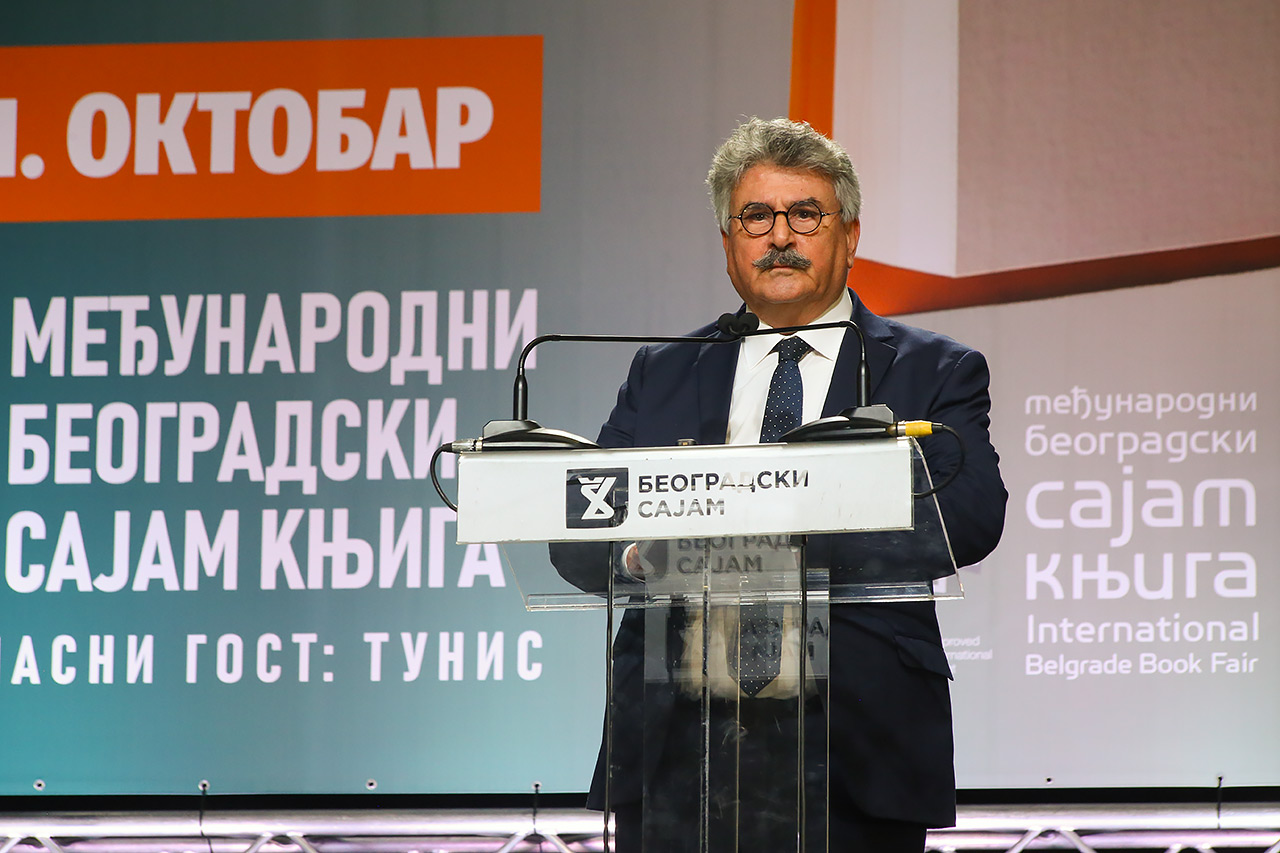
On behalf of the Guest of Honor country, the participants of the Fair were greeted by Dr. Khaled Kchir, Director of the Tunis International Book Fair.
“Literature is the art of creating beauty in and through language; it is the skillful, cultivated use of words, shaped by the historical circumstances of human experience and the geographical frameworks in which it unfolds. Tunisian literature is an inseparable part of the global written word and a clear, prominent element of Arabic literature, both ancient and modern — a tributary feeding its great river. It found its deep inspiration in Tunisia’s unique geographical position, its turbulent history, and the succession of civilizations that have flourished on its soil for more than three thousand years. Its developmental path has flowed steadily — from traditional poetry and prose, through the modern poem in free verse or prose, all the way to sophisticated forms of narrative creation, among which the novel, drama, autobiography, and literary portrait stand out in particular.
The first chapters of Tunisian literature were written in the eighth century AD and the decades that followed. At that time, Ifriqiya — which encompassed present-day Tunisia, part of Algeria, and western Libya — was united under the mantle of its first capital, Kairouan, before the seat of power later shifted to Mahdia and Tunis. As a brilliant beacon of knowledge, thought, and literature, this city soon exerted a powerful influence on all the cities of North Africa. At the same time, it served as an indispensable link between the Arab-Islamic East, the Maghreb, and Al-Andalus — a bridge over which the fruits of learning and the richness of intellectual and literary life traveled from Greece, Byzantium, and the ancient lands of the East toward Southern Europe, helping to pave the way for the modern European Renaissance.
Throughout its history, Tunisia has witnessed a rich and continuous succession of intellectual and literary movements. This was especially evident during the Zirid, Hafsid, and Husainid periods, as well as through the epoch of the modern renaissance. The latter period was primarily marked by a wholehearted struggle against French colonial rule, followed by the contemporary era which began with the acquisition of independence in 1956 and continues to this day.
At every stage of its development, Tunisian literature has maintained a close connection with community life and human destiny, focusing on questions of identity, freedom, and reform. With the dawn of the modern era, themes of colonialism, national struggle, and comprehensive social, political, and cultural transformations took center stage. At the heart of these upheavals were issues concerning the emancipation of women, workers’ rights, as well as the theme of the deep socio-economic divide separating certain regions and groups within Tunisia.
In the medieval period, Tunisia brought forth the exceptional prose writer and literary critic Ibn Rashiq al-Qayrawani, author of the monumental work Al-ʿUmdah fī maḥāsin al-shiʿr wa-naqdihi wa-ādābihi (The Mainstay Concerning Poetry’s Embellishments, Criticism, and Its Art). From the same era comes the extraordinary poet Ali al-Husri al-Qayrawani, author of the collection Iqtirah al-Qarih wa-Ijtirah al-Jarih (The Lamentation of the Wounded Heart and the Injury of the Grieved), which entered history as the first Arabic collection entirely dedicated to mourning and the loss of sons. Simultaneously, his famous poem Ya Layl al-Sabbu Mata Ghaduhu? (O Night, When Will the Dawn of Lovers Break?) remained one of the most famous and beloved love songs composed in the Arab world. Because of this, Ibn Rashiq and Al-Husri occupy a place at the very pinnacle of Arabic literature as a whole, and not just within Tunisia.
New movements and the contemporary era brought an expansion of the ranks of literary creators, opening up space for a multitude of illustrious names. Among them is Abu al-Qasim al-Shabbi: a poet of love and pure passion, who through songs and harmonies portrayed womanhood; a poet of romanticism and nature, who made Tunisia greener in the imagination; and a poet of freedom, whose rebellious verses gave us the immortal words:
If a people one day desires to live,
destiny must answer the call.
From the ranks of these unique creators stands out Ali Douagi (Ali al-Du’aji), the authentic narrator of the collection Bilād al-Tararnī (The Land of Tararni), and the author of the works Sahirtu Minhu al-Layālī (Sleepless Nights Because of Him) and Jawlah bayna ḥānāt al-Baḥr al-Abyaḍ al-Mutawassiṭ (A Tour of the Taverns of the Mediterranean). There is also Mahmoud Messadi, a creator recognizable by prose imbued with the philosophy of existentialism and spiritual mysticism, shaping a text that possesses a wondrous power. He is the author of Al-Sudd (The Dam) and Ḥaddatha Abū Hurayrah Qāl (Thus Spoke Abu Hurayra). Rounding out this lineage of greats is Béchir Khraïef, a supreme master of realism in prose, renowned for his achievements Al-Daqlah fī Arājīnihā (Dates on Their Stalks) and Barq al-Layl (Night Lightning).
In the dramatic arts, writers like Ali Ben Ayyad and Habib Boularès left an indelible mark. Within the realm of poetic creation, the names of Zoubeida Bchir, Mnauwar Smadah, and Ouled Ahmed (al-Sghayar Oulad Ahmed) shine with particular brilliance, while in literary criticism, Farid Ghazi and Tawfiq Bakkar make their precious contributions, alongside many others whose creations merit equal respect and admiration.
SERVICE INFORMATION
Opening Hours
The opening hours of the 69th International Belgrade Book Fair are from 10:00 AM to 8:00 PM.
Tickets and Parking:
Individual ticket is 450 RSD;
Ticket for group visits is 350 RSD;
Ticket for Family Day is 1400 RSD;
Parking for cars is 300 RSD per hour.
School Day – Thursday, October 29, intended for organized visits by students, teachers, school librarians, university students, and professors.
Family Days – Monday and Tuesday, October 26 and 27, when the whole family can visit the manifestation with a single purchased family ticket.
Today, the literary scene of this country is experiencing a true blossoming, bearing witness to an extraordinary richness of creative voices that is almost impossible to list individually within the scope of this presentation. Among contemporary poets are Moncef Ouahibi, Moncef Mezghanni, Adam Fathi, Fadhila Chebbi, Jamila al-Majri, and Amal Moussa.
When it comes to contemporary prose expression, the indispensable names are Hassouna Mosbahi, Habib Selmi, Hassanine Ben Ammou, Chokri Mabkhout, Mohamed Aïssa Meddeb, Amna Rmeili, and Amira Ghenim.
In theatrical art, Ezzedine Madani represents an entire generation unto himself—he is simultaneously a unique figure and a multitude of voices, with fifty full-length plays to his credit.
The modern epoch brought with it a linguistic dualism that provided the opportunity for Tunisia’s writers, both men and women, to express themselves creatively in French as well. From this intertwining grew a firmly rooted tradition of writing whose authors felt Tunisia deeply, carefully listening to its pulse, finding fresh and striking ways to name and interpret its reality. At the very top of this distinctive creative constellation stand, among many others, Albert Memmi, Abdelwahab Meddeb, Abdelaziz Kacem, Amna Belhaj Yahia, Taher Bekri, and Azza Filali.
This exhibition opens the doors to a deeper understanding of the lives and works of many of the literary figures mentioned here, as well as many artists of various profiles. Yet, this fertile soil offers far more expansive creative horizons, characterized by an authentic poetic sensibility and a unique world of imagination. It creates a boundless space in which the distinctive identity of a people is reflected—their eternal questions about the universe and humanity, as well as their inexhaustible yearning for a wider, nobler, and more just world.”
During the 69th International Belgrade Book Fair, visitors can expect a rich selection of new titles from domestic and world literature, professional and popular editions, books for children and youth, as well as works that have marked different eras and generations of readers. The fair is also an opportunity to replenish personal libraries at more favorable fair prices, discover new authors, and find books to which readers always return.
A diverse accompanying program will take place in the presentation halls and at the exhibitors’ booths. You can view the schedule of the accompanying program on the website sajamknjiga.rs